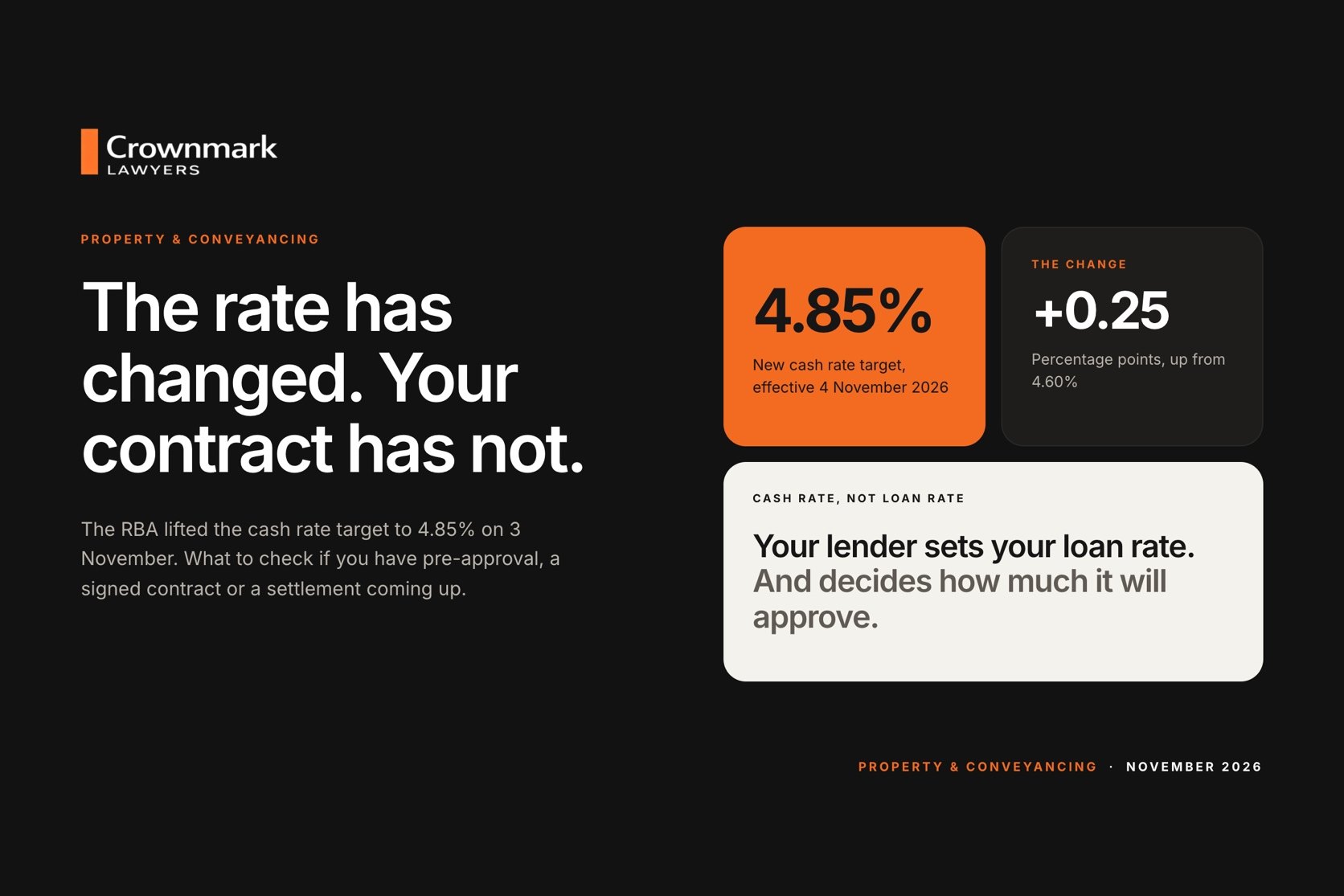
The RBA lifted the cash rate target to 4.85% on 3 November 2026. What to check if you have pre-approval, a signed contract or a settlement coming up.
On Tuesday 3 November 2026 the Reserve Bank of Australia increased the cash rate target by 0.25 percentage points, from 4.60% to 4.85%. The new rate took effect on 4 November 2026. The Bank said inflation remains elevated and that a further tightening was warranted to bring it back to target.
If you are part way through buying a property this spring, the question is not what the Reserve Bank does next. It is what this decision changes for you, at the stage you have reached. For some buyers it changes very little. For others, particularly anyone still relying on a pre-approval or a finance condition, it is a reason to check their position this week.
This article sets out what to check at each stage, from preparing an offer to the day the keys change hands.
1. The cash rate is not your home loan rate
The cash rate is the rate the Reserve Bank sets for overnight loans between banks. It is not the rate on your loan. Each lender decides its own home loan rates, including whether to change them after a Reserve Bank decision, by how much and from when. Some lenders pass on a change in full, some do not, and the timing differs.
Three things are often confused at this point:
- Your loan rate. Set by your lender, not the Reserve Bank. A variable rate can change; a rate that is already fixed generally stays fixed for its term.
- Your borrowing capacity. Lenders test whether you could still meet repayments at a rate above the one you will actually pay. When rates rise, the amount a lender is prepared to approve can fall.
- Your contract. A signed contract of sale is not affected by the cash rate at all. The price, the deposit, the settlement date and any conditions stay exactly as written.
Questions about your loan, your repayments and how much you can borrow are for your lender or broker. Questions about what the contract requires of you, and by when, are for your lawyer or conveyancer.
2. If you have pre-approval
A pre-approval is an indication, not a promise. It is usually given against the lender's rates and tests at the time, and it can be reassessed before formal approval. If your pre-approval was issued before 3 November, ask your lender or broker to confirm in writing that it still stands at the amount you are relying on, and when it expires.
3. If you are preparing to bid or make an offer
Private sale
In a private sale, the contract can include a finance condition, so the purchase depends on your loan being approved within a set period. Make sure the condition names a realistic approval date and the lender or loan you will actually be using, and have the contract reviewed before you sign.
Auction
At auction there is no finance condition and no cooling-off. A successful bid at a Victorian auction is an unconditional contract, so finance needs to be settled before the day, not after it. Our article on buying at auction in Victoria sets out the other checks to make first.
No finance condition at auction. If you bid and win, you are bound to complete the purchase whether or not your lender approves the loan. Confirm your finance after the rate change, and have the contract reviewed, before auction day.
4. If you have signed a contract
The rate change does not rewrite your contract, and your obligation to settle does not change. What may need attention is your finance.
If finance conditions are still outstanding
Read the finance condition now. Note the approval date by which the loan must be approved, and what the condition requires you to do if the loan is refused. The contract usually requires written notice to the seller, with evidence that the loan was not approved, within a short window. Missing that window can leave you bound to buy without finance. If your lender is reassessing your application after the decision, tell us early so the deadline is not missed.
Cooling-off
In a private sale you have a cooling-off period of three clear business days after you sign, unless an exception applies. If you end the contract in that time, the seller can keep $100 or 0.2% of the price, whichever is more.
Cooling-off does not apply to a purchase at a publicly advertised auction, or to a contract signed within three clear business days before or after one. It also does not apply if, for example, you received independent legal advice about the contract before you signed it.
5. If you are approaching settlement
The weeks between contract and settlement are where most problems can still be fixed. Use them to check:
- that your loan has moved from conditional to formal approval, with nothing left outstanding;
- whether your lender has locked a rate for you, until when, and what happens if settlement moves past that date;
- that the deposit balance, stamp duty and settlement funds will be where they need to be on the day;
- that you tell us early about any change in your circumstances, such as a change of job or a new debt.
If you cannot settle on time. The contract can charge you penalty interest from the settlement date, and the seller can serve a default notice. If it is not remedied, the seller may be able to end the contract and keep the deposit. Tell us the moment a delay looks possible, so we can negotiate an extension before it becomes a default.
6. What to ask your lender this week
- Has my pre-approval or application been reassessed since 3 November, and is the amount the same?
- Will my loan rate change, by how much and from when?
- When does my approval expire, and can it be extended if settlement moves?
- Are there conditions still to be met, such as a valuation or updated payslips?
Get the answers in writing. A phone call is useful; an email you can rely on is better.
7. Before you send any money
Settlement season is also scam season. Criminals send emails that look like they come from a lawyer, an agent or a lender, asking the buyer to pay into a "new" account. Once the money has gone, it is rarely recovered.
We will never change our bank details by email. If you receive a message that appears to come from us, your agent or your lender asking you to pay into a new account, call us on a number you already know before you transfer anything.
8. How Crownmark Lawyers can help
We cannot tell you what rates will do next or which loan to choose. That is a question for your lender, broker or financial adviser. What we can do is read the contract before you sign, explain exactly what the finance condition requires and by when, act on it for you within the deadline, deal with the seller's side if settlement needs more time, and make sure the money moves safely on the day. Our contract of sale review and residential conveyancing pages explain how that works.
Our work is offered under Crownmark Assured Pricing (CAP): a fixed fee, agreed before any work begins, so you know the cost of the advice before you commit to it. If you are buying this spring and want the contract checked before you commit, book a consultation or call 1800 884 751.
This article is general information about Victorian property law and is current as at 5 November 2026. The cash rate figures are from the Reserve Bank of Australia's monetary policy decision of 3 November 2026. It is not legal or financial advice and does not take account of your circumstances. For advice on your situation, please contact us or another qualified Victorian practitioner. Liability limited by a scheme approved under Professional Standards Legislation.

Written by
Managing Partner · LL.B · BBus (Acc)(Fin Risk) · IPA · IFA · GDLP · LPMC