

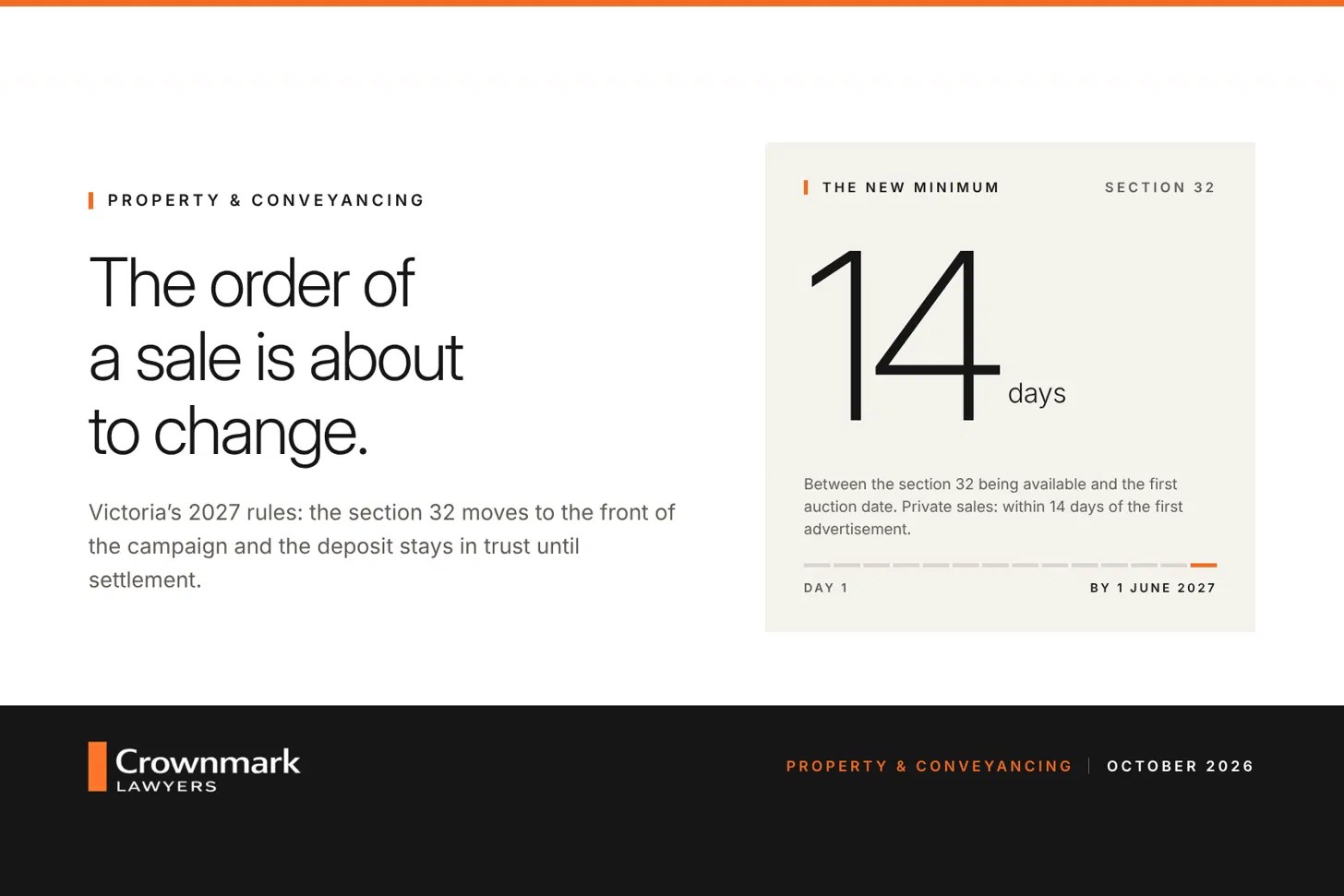
From 2027 the section 32 statement must be available 14 days before an auction, and section 27 early deposit release is repealed. What changes, when, and what to do now.
The Consumer Legislation Amendment Act 2026 received Royal Assent on 8 September 2026. Its first property changes started on 1 October 2026. The property price statement replaced the old statement of information and must now appear prominently in online advertising for all Victorian residential property, private sales included. Published reserve prices apply only to auctions and fixed-date sales, and those requirements apply to sales held on or after 16 October 2026. We covered those in our article on Victoria’s reserve price rules.
The second wave is larger and reaches every residential sale in the state. The vendor statement under section 32 of the Sale of Land Act 1962 will have to be available 14 days before an auction or fixed-date sale, or 14 days after a private sale is first advertised. The current rule, before the buyer signs, will continue only where the property is not advertised or sells within those 14 days. Section 27, which has allowed deposits to be released to sellers before settlement for decades, is being repealed. Sellers and buyers can still agree to early release through a condition in the contract, but agents will no longer be able to take commission directly from a deposit released before settlement. The section 32 rules start on a day to be proclaimed and no later than 1 June 2027. The deposit rules start no later than 1 July 2027. A property listed next autumn may be sold under them. This article explains what changes, who it affects and what to do now.
What Changes and When
Already in force, from 1 October 2026. A property price statement has replaced the statement of information and must appear prominently in online advertising for all residential property, private sales included. For auctions and fixed-date sales held on or after 16 October 2026, the reserve price must also be published at least seven days out.
By 1 June 2027: the section 32 timing rules. The vendor statement must be available from a set point in an advertised campaign, or before signing where the property is not advertised or sells early, and a buyer may be able to rescind the contract if it is not.
By 1 July 2027: the deposit rules. Section 27 is repealed. A deposit cannot be released to the seller before settlement unless the contract provides for it, and an agent cannot take commission directly from a deposit released before settlement.
Proclamation can bring either date forward. Both sets of provisions commence on a day to be proclaimed. The dates above are the latest they can start, and contracts signed in the first 28 days after the section 32 rules commence stay under the current rules.
The Section 32 Statement Must Be Available Earlier in Most Campaigns
Today, section 32 requires the seller to give the buyer the vendor statement at any time before the buyer signs. Many campaigns launch before it is finished, and some auction buyers are reading it in the final days. The Act introduces a sale availability time: the point from which the signed statement, in hard copy or electronic form, must be available to prospective buyers.
Auction or fixed-date sale: from the day that is 14 days before the first auction date or the first fixed date.
Other publicly advertised sales, which covers most private sales: from the day that is 14 days after the property is first publicly advertised.
Property that is not publicly advertised: before the buyer signs the contract, as now.
A sale inside the window: if the property sells within 14 days of first being advertised, or more than 14 days before the first auction or fixed date, the statement must be available before the buyer signs.
The seller must also give the buyer written notice of any change to the statement before the buyer signs. A statement prepared in March and signed against in May needs to be checked in between.
⚠️ The certificates set the auction date, not the other way round. A section 32 cannot be finalised until the title search, planning and building information, the owners corporation certificate, rates, land tax and water information are in, and some can take weeks to respond. Under the new rule the earliest auction date is 14 days after the statement is ready, so a late certificate moves the auction, not just the paperwork. Our article on getting the legal work moving before the campaign sets out what to order first.
If the Statement Is Late, the Buyer May Be Able to Walk Away
Rescission. Section 32K will allow a buyer to rescind the contract where the statement was not available from the required time, at any time before the buyer accepts title and becomes entitled to possession, which in practice means before settlement. The Act’s existing safeguard for a seller who acted honestly and reasonably, where the buyer is in substantially as good a position, is expected to remain available, but it is an argument for a courtroom, not a plan for a campaign.
Penalties. Under section 32L, a seller who knowingly or recklessly fails to give a signed statement before the buyer signs, or supplies false or incomplete information, commits an offence carrying up to 60 penalty units for an individual and 300 for a company, currently $12,546 and $62,730. Published commentary on the Act indicates the same offence will apply to a failure to meet the new availability time.
No cure after signing. Handing over the statement after the contract is signed does not of itself fix a timing breach, although a court can refuse rescission where the seller acted honestly and reasonably and the buyer is in substantially as good a position. The Act does not create a new cooling-off period that runs from the day the statement finally arrives.
A short transition. Contracts entered into within 28 days after the section 32 rules commence are governed by the current rules.
Section 27 Is Repealed: The Deposit Stays in Trust Unless the Contract Says Otherwise
Victorian sellers have long been able to ask for the deposit before settlement through section 27. The seller serves a section 27 statement with particulars of any mortgage or caveat, the buyer has 28 days to object, and if no valid objection is made and no condition of the contract is still operating for the buyer’s benefit, the deposit is released. The process has no direct equivalent in New South Wales, where early release is a matter for the contract, and the question of when a condition is still operating has produced years of argument.
The Act repeals section 27 and replaces it with two new provisions:
Section 26A: no early release without a contract condition. A deposit held by the estate agent, lawyer or conveyancer must stay in trust until settlement unless the contract itself contains a condition, agreed by both parties, that provides for release earlier. Early release becomes a term to negotiate before signing, not a statutory process to run afterwards.
Section 26B: the agent is not paid from a released deposit. Where a deposit is released early, the agent must not retain commission, auction expenses or any other amount out of it before settlement or rescission. An agent can still be paid earlier by the seller, rather than out of the deposit, if that is what the seller agrees.
Off-the-plan deposits are unchanged. Section 9AA still requires an off-the-plan deposit to be held until the plan of subdivision is registered. Our article on off-the-plan sales in Victoria explains how those deposits work.
⚠️ Buyers: read any early-release condition before you sign. Once section 27 goes, the only way a seller receives the deposit before settlement is a condition you agreed to. A released deposit sits with the seller while you still depend on the seller to settle, and if the sale falls over you are chasing the money rather than holding it. You are entitled to say no, and a seller who needs the deposit to fund the next purchase should expect the question.
What Sellers Should Do Now
Order the section 32 before the campaign is planned. Under the new rules the statement sets the earliest auction or fixed date, so it should be the first instruction, not the last.
Decide early whether you need the deposit before settlement. If the sale is funding your next purchase, the early-release condition has to be in the contract from the first day of the campaign, drafted so a reasonable buyer can accept it. Have a plan, such as bridging finance or a longer settlement, in case the buyer declines.
Budget for commission at settlement. Unless you agree to pay the agent from other funds earlier, commission and marketing costs come out of the settlement proceeds.
Keep the statement current. Any change after it is made available must be notified in writing before the buyer signs, so tell your lawyer about new notices, works or tenancy changes as they happen.
Selling in late 2026 or early 2027? The dates above are backstops, and proclamation can bring them forward. A campaign planned to the new rules is also a campaign that complies with the current ones.
What Buyers Gain
Time to read the statement. At least 14 days before an auction, and from two weeks into an advertised private campaign. If you buy sooner, or the property is not advertised, you must have it before you sign, as now. Use it to have the contract and section 32 reviewed before you bid or make an offer. Our article on buying at auction in Victoria sets out what to check.
A clear position on the deposit. Unless you agree to an early-release condition in the contract, your deposit stays in trust until settlement.
A remedy if the rules are broken. Rescission where the statement was not available in time, up to the point you accept title at settlement.
Two clocks at auction. The reserve must be published seven days before the auction and the section 32 available 14 days before it. If either is missing, ask why before you register to bid.
What Agents Need to Change
Campaign timelines. An auction or fixed date cannot be set until the statement will be available 14 days ahead of it, and in an advertised private campaign the statement must be available by day 14, or before signing if a buyer is ready sooner. The listing date and the section 32 instruction need to be planned together with the vendor’s lawyer.
Commission timing. Commission and auction expenses are paid at settlement unless the vendor agrees to pay them earlier from other funds. Agency agreements and cash flow assumptions built on early deposit release will need to change.
Early-release conditions move into the contract. A vendor who wants the deposit early needs the condition drafted before the campaign, because it cannot be added after the buyer signs.
Trust account audits. Since 9 September 2026 the Business Licensing Authority has been able to suspend an estate agent’s licence for failing to comply with trust account audit requirements.
Crownmark Lawyers acts for sellers, buyers and agents across Victoria, from section 32 statements and contracts of sale through to deposit conditions, campaign timing and settlement. If you are planning a sale in 2027, we can prepare the section 32 and the contract now, including any early-release condition, so the campaign can start on the day you choose. Under Crownmark Assured Pricing, the fee is fixed and agreed before the work begins.
This article is general information about the Consumer Legislation Amendment Act 2026 (Vic) and the Sale of Land Act 1962 (Vic) and is current as at October 2026. It is based on the Act as passed with the amendments made in the Legislative Council. The section 32 and deposit provisions commence on proclamation and no later than 1 June 2027 and 1 July 2027 respectively, and regulations or guidance may be issued before then. It is not legal advice and does not take account of your particular circumstances. For advice on your sale or purchase, please contact us or another qualified practitioner.

Written by
Managing Partner · LL.B · BBus (Acc)(Fin) · IPA · IFA · GDLP · LPMC
